Is using a Digital or Mobile Wallet a good idea — are they really safe?

The names might be different but they all refer to the same thing: making payments securely with a device. Some of the most popular mobile wallets include Apple Pay, Google Pay, Microsoft Pay, and Samsung Pay, and contrary to what many people think, these payment methods are generally considered to be more secure than using a physical card to make purchases. Physical cards feature an identifying magnetic stripe, and information can be stolen from them rather easily if criminals tamper with a card reader by adding a skimmer.              

A digital wallet — is even more secure than a chip card because it doesn’t use your actual card number for the transaction. As a security measure, your card information is only used in the initial setup of the wallet, helping increase mobile payment protection. Then, the device’s Wallet creates a token (think of it as a temporary card number) that is encrypted and used in place of your card number. The token number is not directly tied to your account, so even if someone were to hack into the merchant and break the token encryption, they wouldn’t be able to access your card or personal information. Additionally, the token isn’t a standard card number that could be used anywhere. It is specifically coded for each transaction, which makes it unusable beyond its intended transaction.

Mobile payment options also offer the added benefit of convenience, since everyone has their phone with them everywhere they go. Transactions via a device are frequently quicker as well. In one study, Apple Pay took just one second, while a card swipe lasted 12. That 11-second difference might seem trivial, but when you’re standing in a long line at a coffee shop or grocery store, that time makes a big difference. Digital Wallets can also be used for online or digital purchases, such as paid apps or subscriptions. 

Mobile Pay can be used for both credit and debit cards and is one more step to no more bulky wallets. 

As we continue to infuse technology with convenience, security will remain a forefront concern for individuals and businesses, especially concerning their financial information. That being said, mobile pay is arguably the safest and most dependable digital method for transactions today. Mobile payment protection technology will continue to evolve and strengthen with each new yearly iteration of device technology. Every day, more and more individuals are deciding to keep their debit cards in their physical wallets, and instead reach for their phone or tap their watches and use a safe mobile payment option. 

Learn More

It’s Easy to Enroll

In the The Callaway Bank app, look for the “Add To” option in Digital Banking to enjoy instant Digital Wallet access for your watch and phone!

In Digital Banking > Manage Cards > Tap The Card You Want To Add!
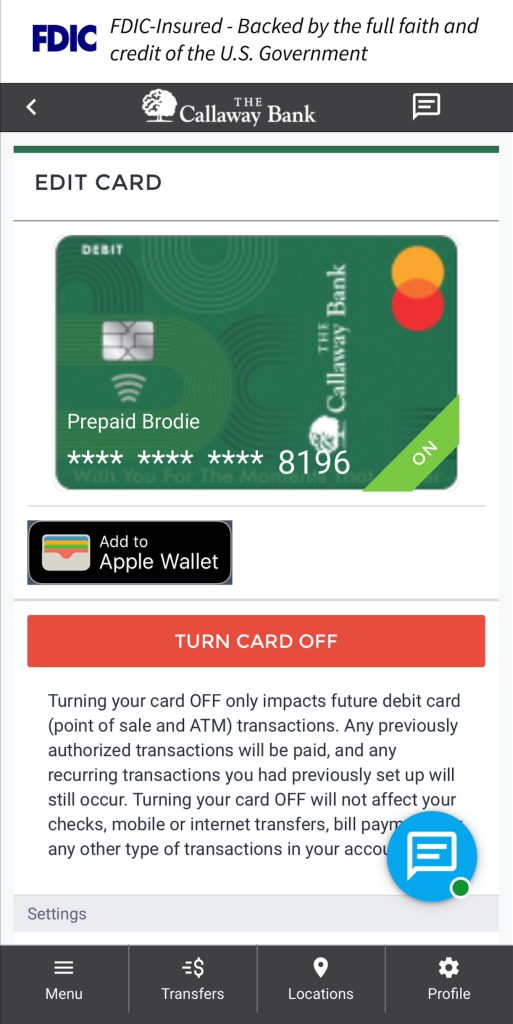
The Callaway Bank Digital  Wallet


Consumer Alert: Mortgage Scam

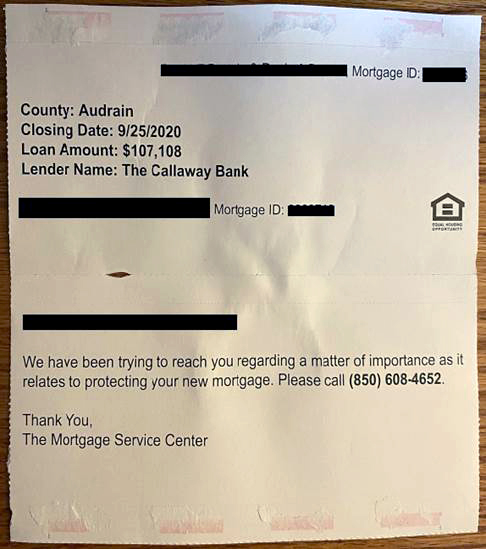
Have you received a postcard or letter with “an important matter” regarding your mortgage?

Have you received a postcard or letter about a time-sensitive issue with your mortgage urging you to call an unknown phone number? If you have, you are not alone. Scammers all across the country are pulling public data records to target you and your information.

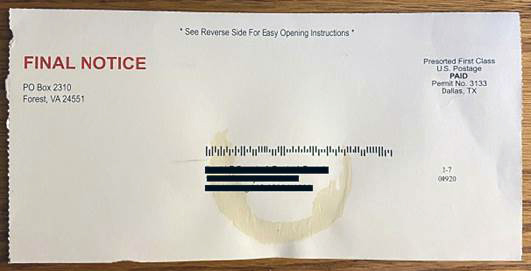
The first thing to understand is that these mailings did not come from The Callaway Bank or any other financial institution. They are sent to homeowners in the hopes of selling them something or, most often, to steal their identity by tricking them. Recipients are asked to call a phone number about an “important matter” with their loan. This scam is especially tricky because it looks like a late notice or official letter that mentions your lender by name.

The notices will often have a small disclaimer on the bottom stating, “Not Affiliated With” and your lender name. However, in the example below, there is no mention of that.


Final Notice Scam MailMortgage Scam Mail


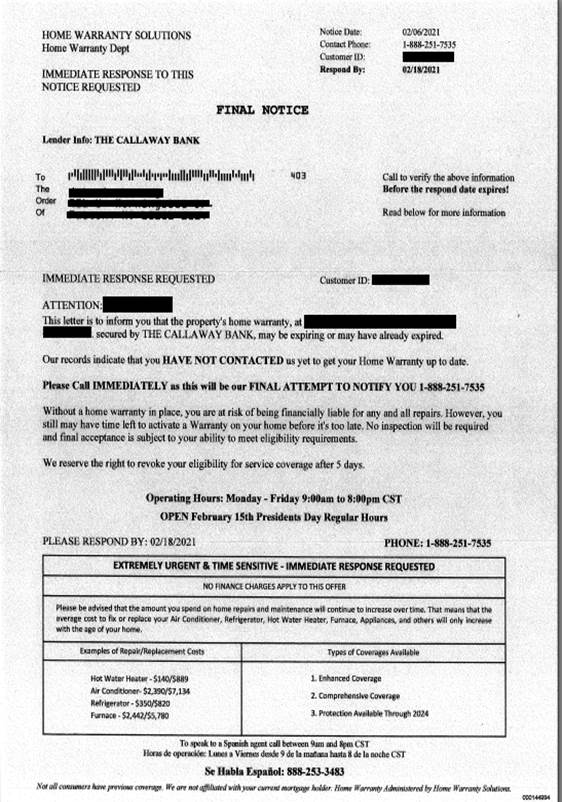
The example seen below is from Home Warranty Solutions and mentions The Callaway Bank as the lender. According to The Better Business Bureau, Home Warranty Solutions has a C rating and not BBB Accredited. The letter also gives the impression that they are working with the bank. But that is not true at all.


Home Warrenty Solutions scam mail


The Callaway Bank is committed to protecting your personal information, and we do not sell or otherwise distribute it to non-affiliate third parties. There is some information with mortgages, regardless of what lender you might have worked with, that is public record. Public Record entries are how scammers like this obtain your information. For example, companies can get information from a county recorder’s office, such as lien filings or property purchase and transfer documents, which are all public records. The records and the information they can gather are used to develop letters with detailed information to help legitimize the “important matter” they refer to.

If you receive the notice, disregard and dispose of it as you would any other junk mail. Calling the number may connect you with a real person, or it may connect you to an automated recording. Regardless, do not offer your personal information. It could lead to some unfortunate problems.

Please contact us for any questions you may have.

How To Fight Cardholder Fraud

fraud alert on computer

Have you ever wondered how your stolen information is used to commit fraud, and what you can do to help prevent it? We have some tips to help you keep your information safe.

Fraudsters have become increasingly adept at getting the information they need to commit fraud by posing as financial institution call center agents, or by sending text messages that look like they are coming from your trusted financial institution, warning of suspicious transaction activities. They are also known to call in to call centers posing as customers requesting changes to their card information and parameters. Fraudsters use information stolen through data breaches (at health insurance providers, reward program providers, credit bureaus, merchant terminals, and social media sites, to mention just a few recent ones) as well as through malware programs deployed on personal computers and other sources. Stolen personally identifiable information (PII) is combined with stolen card information, resulting in sufficient information to create profiles that fraudsters can use to position themselves as the actual cardholders.

Help protect your personal information from fraud by remembering:

A text alert from The Callaway Bank warning of suspicious activity on your card will not include a link to be clicked. You should never click on a link in a text message supposedly from The Callaway Bank. A valid notification from The Callaway Bank will provide information about the suspect transaction and ask you to reply to the text message with answers such as ‘yes’, ‘no’, ‘help’, or ‘stop,’ and will never include a link.

A text alert from The Callaway Bank will NOT be from a 10-digit number resembling a phone number. 

A phone call from The Callaway Bank’s automated dialer will only include a request for a cardholder’s zip code and no other personal information unless they confirm that a transaction is fraudulent. Only then will they be transferred to the Customer Care Team, who will ask questions to confirm their identity before proceeding with the transaction.

If at any point you are uncertain about questions being asked or the call itself, hang up and call The Callaway Bank directly at 800-446-2265 (BANK). Receive a call claiming to be The Callaway Bank call center and asking to verify transactions. You shouldn’t have to provide any information other than your zip code and a ‘yes’ or ‘no’ to the transaction provided.

The Callaway Bank will NEVER ask for the debit card PIN or the 3-digit security code on the back of your card.

Fraudsters posing as call center agents will often ask you to verify fake transactions. When you say no, you did not perform those transactions. The fraudster then says that your card will be blocked, a new card will be issued, and that they need the card’s PIN to put on the new card. Many people believe this and provide their PIN. A real call center agent will tell you to wait until you receive your new card to activate it and set a new PIN.

Regularly check your account(s) online for suspicious transactions, but especially if you are unsure about a call or text message you’ve received. If anything looks amiss, call The Callaway Bank directly for assistance.

If you receive a voice or a text message from The Callaway Bank’s fraud call center and are unsure about responding to it, call The Callaway Bank’s Customer Care Team 800-446-2265 directly for assistance.