We turned $46,500 into $186,000 for Five Area Non-Profits

We turned $46,500 into $186,000 for Five Area Non-Profits 💚

July 30, 2026 – The Callaway Bank has secured an additional $139,500 in gifts to Callaway County by leveraging its $46,500 in charitable contributions through the Federal Home Loan Bank of Des Moines (FHLB Des Moines) Member Impact Fund.

The 3-to-1 matching program quadrupled the impact of the Bank’s original contribution, resulting in $186,000 for five non-profit organizations serving Callaway County residents.

“Our goal was not simply to make a contribution, but to make every dollar we committed work as hard as possible for our community,” said Kimberly Barnes, president and CEO of The Callaway Bank. “By combining our $46,500 investment with the Member Impact Fund, we were able to bring another $139,500 into Callaway County. That means more resources for families, housing, the arts, local entrepreneurs and food security.”

The combined funding will support:

🏊  Callaway County YMCA — $100,000 for their community pool campaign
🏠  Fulton Area Development Foundation — $40,000 for housing development
🎭  Brick District Playhouse — $20,000 for teaching and presenting children’s theater
💡  Callaway Chamber of Commerce — $16,000 for entrepreneur Pitch Competition
🥫  SERVE, Inc. — $10,000 for their food pantry facility

The Callaway Bank made the initial $46,500 in contributions through TCB Cares, the Bank’s community-giving and employee-volunteer program. The Bank then worked with FHLB Des Moines to obtain an additional $3 for every $1 it contributed through the Member Impact Fund.

This matching grant program is designed to amplify the community engagement of FHLB Des Moines member institutions that support local housing, business, and economic needs.  In Missouri, 956 applications received funding through partnerships with 174 member institutions. FHLB Des Moines matched $3 for every $1 contributed by a member institution, resulting in $6.5 million from members and $19.4 million awarded by FHLB Des Moines.

“This partnership allowed us to do something especially meaningful,” Barnes said. “We were able to take dollars generated here, multiply them and bring substantially more funding back into the community. It is a strong example of what a locally owned community bank can accomplish by using its relationships on behalf of the people and communities it serves.”

Since its launch in 2023, the Member Impact Fund has provided more than $106 million in grants from FHLB Des Moines, generating over $144 million in combined support for affordable housing and community development. Notably, every eligible application submitted to the program has received funding, reflecting the Bank’s strong commitment to partnership and impact.

“The Member Impact Fund is designed to help our members champion the organizations that make a real difference in their communities,” said Kris Williams, president and chief executive officer of FHLB Des Moines. “By partnering with our members, we’re able to multiply resources and support their vital work as they continue to strengthen opportunities for the people they serve.”

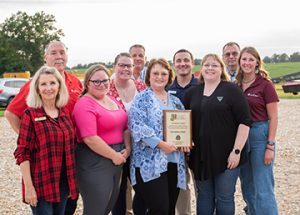
Representatives of The Callaway Bank, FHLB Des Moines, and the five recipient organizations gathered on July 29 at the Brick District Playhouse in Fulton to recognize the awards and discuss the projects the funding will support.

The organizations will receive their allocated funds before the end of August 1, 2026.
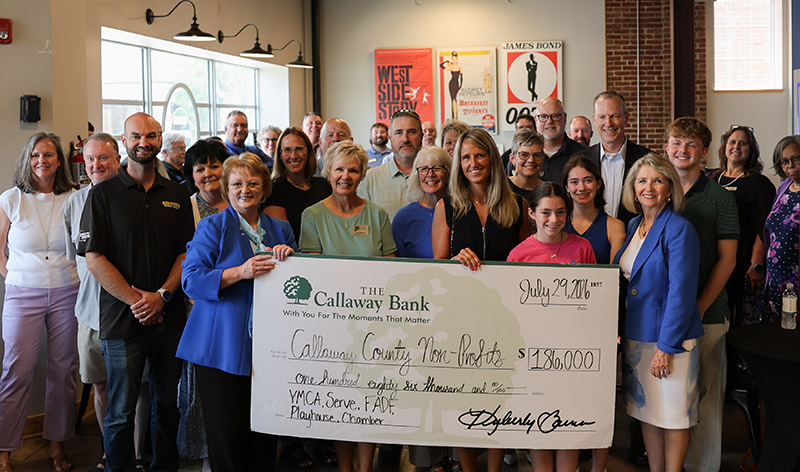
Check presentation for $186,000 donation to 5 area non-profits.

Updated Website Coming Soon

Exciting Updates Coming Soon to Our Website! 

It’s home improvement season, and just like many homes this spring, our website is getting a fresh coat of paint and some new fixtures. In the next few weeks, we’ll be rolling out a refreshed and updated look to the site aimed at making your experience even better.   Nothing drastic, and the Digital Banking login box will still be in the same top right corner of the page!    

Here’s what you can look forward to: 

  • Improved Navigation and Search: Finding what you need will be quicker and easier than ever before. 
  • Mobile-Friendly Design: Whether you’re on your phone or tablet, our new design will look and work great on any device. 
  • New Financial Calculators: We’re adding interactive tools to help you make smarter financial decisions. 

Lemonade and House Renovation

We promise to make this transition as smooth as possible for everyone, and we can’t wait to share the new experience with you. Stay tuned for more updates, and thank you for being a part of our bank’s family!

Password Security Check: Alerts You if Your Password is Found on the Dark Web

Password Security Check

We’re excited to introduce Password Security Check, a new free service from The Callaway Bank that helps protect your Digital Banking.  It works by comparing your password against those exposed in known data breaches or on the dark web.  If the system finds a match, you’ll get an alert when you log into Digital Banking, encouraging you to change your password.

Why Is This Important?

Recent research shows that 94% of leaked passwords are either reused or weak, meaning the vast majority of online accounts are protected by shaky measures. That’s because only about 6% of exposed passwords were unique, leaving the rest dangerously predictable and reusable across multiple sites.1  Additionally, passwords that have been collected through countless breaches over the years are available on the dark web for hackers to access.  Why try to guess passwords when they can start with the most common ones?

How Does Password Security Check Work?

This new service, provided by The Callaway Bank, is free and will automatically run in the background for all of our Digital Banking clients.  The system compares your password against a constantly updated database of exposed passwords.  It’s important to understand that finding a match does NOT mean your account has been hacked. It does mean that your password matches those of other people whose passwords were compromised.  Hackers could, however, try to use it to access your accounts. This Password Check helps spot that risk before it becomes a problem.

What’s the Benefit To Me?

Our Password Security Check adds an extra layer of protection to your online banking—helping keep your account safe from fraud and unauthorized access.

Who at the Bank Can Access my Password?

Nobody within the Bank can see or access your password. Our banking system does not allow anyone to view your password.  But because the system knows your password, it can compare it to the database of other compromised passwords.

When Will Password Security Check Be Active?

February 24th will be when it goes live.

Want to Know More about Creating and Using Stronger Passwords?

When you manage your money and accounts online, the strength of your passwords matters more than ever. We’ve put together seven tips on how to make your passwords stronger and easier to manage.


Source:
1https://cybernews.com/security/password-leak-study-unveils-2025-trends-reused-and-lazy/

Financial Fraud Attempts Growing

Financial Fraud Attempts Growing

Data breaches, unfortuanately, have become a common occurance in this modern world.  High-severity breaches include sensitive data such as social security numbers and passwords. With so many of these instances, it is essential to review your statements and monitor your accounts regularly. 

At the Bank, we continue to see the number of attempts by fraudsters to gain access to client accounts grow. They use the information found on the dark web from the hundreds of data breaches to impersonate the customer on the phone. (This is why we go to such lengths to accurately identify you when you call into our Customer Care Team.) Or with that info, fraudsters can sometimes guess the client’s ID and password for online banking, which they will then use to transfer funds or send payments to fake businesses.

How can you best protect yourself from these scenarios?

  • Check your statements routinely and call the Bank if you see any irregularities.
  • Use long passwords with at least ten characters and a mix of alphanumeric characters (A, b, 1, 9) using upper and lower case and symbols (@, $, %, *).
  • Never use the same passwords on multiple sites.
  • Speak to a banker to set up a security challenge pass-phrase that must be shared before making any changes to account(s).
  • Never use your mother’s maiden name or other easily obtained information for passwords or security phrases. These can be found on genealogy sites or learned from your social media. 
  • Update the Bank with your current contact info, particularly your cell phone number.  This helps us contact you faster if we notice something odd with your account.
  • Those fun quizzes on social media about “have you ever” or trivia contests – don’t do it. Those are often collection points for hackers to gain extra info about you. 

 Other tips and resources for protecting against financial fraud are available here.
Fraud Protection Tips

If you ever notice something odd or feel your account may have been compromised, please always contact the Bank immediately. 

 Ashland: 573-657-0849  |  Columbia: 573-447-1771  |  Fulton: 573-642-3322  |  Mokane: 573-676-5711
Or Reach Any Locations Using:
 800-446-2265

A Guide to the Corporate Transparency Act for Missouri Business Owners

As a Missouri business owner, navigating the complexities of business regulations is challenging. Now, there’s a new law in effect that every owner needs to know about: the Corporate Transparency Act (CTA). While the thought of tackling another requirement may feel daunting, rest assured that The Callaway Bank’s Business Banking Team is here to guide you through the process.  

Helpful CTA Links for Missouri Business Owners

What Is the Corporate Transparency Act?  

Effective January 1, 2024, the CTA is designed to increase corporate accountability. The law introduces a critical requirement that many businesses must comply with — the Beneficial Owner Information Report (BOIR). The goal is to boost transparency in business operations to prevent fraud and illegal activities like money laundering. 

Review CTA Reporting Requirements  

A brunette Missouri Business Owner on the phone at his desk, smiling What Is the Beneficial Owner Information Report?  

As the key component of CTA, BOIR involves providing important details about the company’s beneficial owners. While the specifics vary based on the type of ownership, it typically includes names, addresses, and other identifying and trackable details. The report must be filed with the Financial Crimes Enforcement Network (FinCEN) by the specified submission date.  

View All BOIR Submission Deadlines

How Does It Impact Your Missouri Business?  

The CTA has far-reaching implications for a wide range of Missouri businesses. Understanding how it impacts your organization is crucial for ensuring compliance and avoiding potential legal and financial consequences. Here are a few key points:  

  • Who Must File: Most entities registered with the state are required to file a BOIR.  
  • Filing Deadlines: These vary based on when the business was officially established.   
  • Exemptions: There are exemptions, including 23 types of entities.  

For qualifying businesses, compliance is crucial. Failing to meet the CTA reporting requirements can result in legal and financial repercussions.   

Learn More About CTA Exemptions  

How Fraudsters Are Leveraging It  

With new regulations come new opportunities for fraudsters. There are reports of spammers exploiting the CTA by posing as regulatory bodies or legal entities to extract sensitive information from unknowing businesses. They might trick business owners using emails, phone calls, or fake websites. It’s vital to verify the legitimacy of any request for company information and be cautious of unsolicited communication related to the CTA.  


Contact The Business Banking Team

Fraudsters & Encrypted Emails: What You Need to Know

How to Protect Yourself From Encrypted Email Fraud

Modern email services offer valuable anti-fraudulent features, like identifying and removing spam. Yet, as the software has evolved, so have the threats. Today’s fraudsters are taking advantage of the peace of mind provided by state-of-the-art security techniques, like encrypted email messages, to steal your information, such as credit card log-ins and banking credentials. 

Thankfully, learning about their latest deceptive tactics can help you stay protected. 

[Read More: How Much is Your Information Worth?]

Fraud Prevention Banking in Boone County, MO - a brunette woman checks her phone while sitting next to her laptop Why Encrypted Emails Still Pose Risks

Encryption is a digital process that shields information from non-intended parties. In the case of email, it scrambles the details in the message to prevent scammers from accessing the data as it travels from the sender to the recipient — and all the servers in-between. 

While encryption is effective at blocking outside spectators, fraudsters have learned how to get an insider’s view. The thieves gain access to a compromised email — either by tricking the user to click an unsafe link or downloading a nefarious file. They may also purchase their details from other spammers if it is already jeopardized. 

Once inside the account, they send encrypted messages to contacts in their address book. Typically, the email requests the recipient to follow a link. Since the message is from a known user and is encrypted, readers often feel comfortable enough to interact. The resulting landing page appears normal and asks them to log-in, which then allows the fraudsters to gain access to their credentials without them ever knowing. 

How to Protect Yourself From Email Scams

After getting into your email, spammers can reuse the trick on your address book, putting all of your contacts at risk for fraud. They can also use the access to request or alter log-in credentials for other accounts, like changing your banking password. As such, it’s essential to take additional steps to keep your details safe. 

Multi-Factor Authentication

This email scam relies on a single access point to your email account. For that reason, adding an additional layer of proof to log-in can block their movements. Multi-factor authentication requires providing an access code or other acknowledgement sent to a separate device or tool, like a text message, before you can log in. Enabling it on your email accounts — as well as banking accounts — can prevent fraudulent access. 

Contact the Sender

Not opening links or media from unknown sources has become common knowledge. However, since the latest fraud efforts rely on known contacts, it’s important to now use the same level of apprehension when receiving emails from people in your address book. If the message is unexpected, reach out to the contact using another form of communication to verify that they actually sent it before interacting with the email. 

Staying Fraud Free With The Callaway Bank

We understand just how quickly fraud can happen. That’s why we’ve implemented a variety of enhanced security features for our banking accounts, including encryption, firewalls, and multi-factor authentication. We also have a comprehensive list of resources in our Fraud Prevention Center. 

Additionally, our customer care team is available to answer your questions and provide guidance. 


Contact Us

A Homeowner’s Guide to Mortgage Mail Fraud in Mid-Missouri

What Homeowners Need to Know About Reducing Mortgage Mail Fraud

Whether you’re closing on a home or purchased it decades ago, receiving regular updates from your lender is expected throughout the duration of the mortgage. Unfortunately, third-party companies have begun targeting this relationship and sending out large amounts of home loan-based junk mail. These postcards and letters often appear to be from your mortgage lender or another official organization, which can cause confusion and even put you at risk for fraud. Here’s a closer look at who’s sending these documents and how to stop it.

Read More: How to Reduce Mortgage Junk Mail

Where Are These Mortgage Postcards & Letters Coming From?

Some of the companies behind the junk mail are legally legitimate businesses, such as financial lenders and warranty companies. However, they often utilize deceptive practices to get the attention of homeowners across Boone and Callaway counties, such as printing the originating bank’s name on the postcard and adding an account number. Fraudsters also follow the same strategy but operate completely illegally. For example, they may pose as the bank itself.

 The goal of these documents is usually always financial, but they go about it in a few different ways.

The goal of these documents is usually always financial, but they go about it in a few different ways. They may suggest important documents need filing or a payment is due or past due, requesting that you call them as soon as possible. Offering help to prevent foreclosure is another common tactic, along with mortgage modifications, like promise of a lower interest rate.

In most cases, they present just enough detail to lure the homeowner into contacting them in order to convince the homeowner to sign up for an unnecessary service or refinance with their company, which is usually accompanied by substantial fees. If there’s not a legitimate business behind it, the fraudsters may request a wire transfer or pre-emptive payment to steal funds directly.

How Do They Get Homeowner Information?

Applying for a mortgage involves providing an incredible amount of personal detail. At The Callaway Bank, we keep all these details private and protected, never sharing or distributing the data to non-affiliates. However, the purchase becomes public record at closing. As a result, elements included in the deed transfer are easily obtainable through the state or local recorder’s office, including name and location of property. Third parties can pull the information and sell it to other companies or use it themselves for mailers.

New loans, like a mortgage, are also reported to the main credit bureaus: Experian, TransUnion, Equifax, and Innovis. Unfortunately, these credit bureaus often sell personal data to third parties. As such, other companies can pay to access your details, like age, property information, and lender name, and use it for their own gain.

Smiling father and daughter checking their mailbox for mortgage mail.

How to Identify Third-Party Loan Mailers in Mid-Missouri

A major challenge with mortgage junk mail is that the third-party companies replicate the look of official documents. Luckily, there are a few common signs that indicate potential spam or fraudulent materials.

Bright Colors

Typically, banking documents are printed on white or neutral backgrounds. Third-party mailers, on the other hand, may utilize bright colors to catch your attention. Approach red, yellow, and other abnormal shades with caution.

Incorrect Account Information

It’s also common for these documents to list an account number, which makes them appear official. However, it’s seldom the same as the actual home loan account. As such, always be sure to check the number before taking any further steps.

 For that reason, prominent words on the postcard or envelope are likely to evoke panic, like “important”, “urgent”, “time sensitive”, and “final notice”.

Alarming Terms

These home loan mailers are designed to prompt the reader to action. For that reason, prominent words on the postcard or envelope are likely to evoke panic, like “important”, “urgent”, “time sensitive”, and “final notice”. Such terms may be bolded and in larger font than the rest of the text to catch the reader’s attention.

Disclaimer

It’s illegal for these non-affiliate companies to pose as the mortgage lender. Yet, they often mention the name of the bank to confuse readers into thinking they’re directly associated with the financial institution. To prevent such tactics from getting them into legal trouble, they may place a disclaimer on the mailer. Typically, it’s in small print and overshadowed by other elements, so complete a thorough document inspection to identify if such a statement is present.

Husband and wife homeowners in kitchen using laptop to opt out of mortgage spam.

How to Protect Your Information

While it may not be possible to avoid unsolicited mailings altogether, there are a few methods that can reduce unwanted contacts.

Sign Up Online

Consumers have the option to opt-out of pre-screening offers based on credit report information through OptOutPrescreen.com – the official website used by the top four credit bureaus in the U.S. The service allows users to request a temporary five-year ban on data release directly through their website. Simply fill out their online form and provide personal details, like name, address, date of birth, and Social Security number. This step can also help reduce unwanted phone calls.

Permanent Removal

The service also offers a permanent removal option. To opt-out out of their pre-screening offers forever, download the paperwork and mail it in. Once completed, it’s possible to go back and opt-in again through the website.

Reduce Junk Mail

The Direct Marketing Association also allows registrants to specify what – if any – types of marketing-based mail they want to receive, including catalogs. While the junk-mail-suppression service promises 10 years of relief, it requires a sign-up fee. It also isn’t likely to impact any fraudulent senders.

How Your Local Bank Can Help

At The Callaway Bank, we take extensive steps to protect our customers’ data. For example, our fraud prevention system monitors and flags unusual banking patterns to stop fraudsters in their tracks. Our local bank’s Digital Banking solutions also add an extra layer of protection by requiring a secure access code when logging in on-top of utilizing unique username and password details.

Additionally, if you do receive any strange or suspected spam mail, our dedicated bankers are available to check the document’s validity to provide you with peace of mind.

Contact Us

Why The Callaway Bank is Much Safer Than the Big National Banks

Over the weekend, two large banks in the US were shut down by Federal Regulators, Silicon Valley Bank in California and Signature Bank of New York.  Before we go into further detail, let’s first address the biggest question: do these closures affect The Callaway Bank or your accounts here?  The answer is NO.

First and foremost, The Callaway Bank remains well-capitalized and our client base is well-diversified.

DECORATIVE

The Callaway Bank’s risk profile is entirely different and much more conservative than SVB and Signature Bank.  We do not participate in risky things like cryptocurrencies or venture capital.  We have a low-risk balance sheet, and the Bank is well-positioned with strong capital to continue to serve our customers and community for generations to come.  We were chartered 166 years ago and have steadily served mid-Missouri through every period of unrest since 1857, and we intend to keep serving you.

Additionally, as a federally-insured institution, client deposits are insured by the FDIC up to $250,000, and there are potential ways to provide additional coverage.  Nobody has ever lost a dime of FDIC-insured deposits.

If you have questions about your coverage or would like to learn more about FDIC insurance and how it works, we encourage you to contact us directly at 573-642-3322 or take a look at the resources linked below:


What Happened

Silicon Valley Bank was a unique institution because of its heavy focus on start-up technology companies.  Over the past decade, these companies have received immense funding from venture capital funds and introduced SVB to indirect cryptocurrency exposure.  In the past 12 months, however, venture capital funding slowed considerably, and cryptocurrencies have been volatile.  In recent weeks, venture capitalists began instructing companies in their funds to move uninsured deposits out of SVB.  As a result, investors and clients began to fear potential insolvency, and it started to implode.  Bank regulators stepped in on Friday and put SVB into receivership.

Coincidentally, Signature Bank of New York has been struggling due to its heavy reliance on the cryptocurrency business segment.  Volatility in this sector caused Signature’s deposits to decline precipitously, and on Sunday, Signature Bank was closed and put into receivership as well.

The FDIC, Treasury Department, and Federal Reserve have guaranteed that all depositors of both failed banks would recover all their money.  Additionally, they said taxpayers would bear no losses.  If there are any losses to the Deposit Insurance Fund to support uninsured depositors, a special assessment on all banks will recover the difference.  Even though our community bank didn’t cause the problem, we will play our part to stabilize our country’s financial sector.

While some have suggested this is the start of a 2008 repeat, it’s essential to understand that these circumstances are very different. First, even with the economic challenges we’ve seen overall, the economy is much stronger. Second, SVB and Signature Bank were vulnerable to their high-risk reliance on venture-backed and crypto-focused clients.

Our Bank is Much Different

What happened to both of these banks is extremely unfortunate, and for many months to come, people will speculate on how it could have been avoided. Some will suggest additional regulations are needed. However, we suspect what was missing was an adherence to long-proven sound banking principles of risk aversion, risk mitigation, and diversification.

The approach that multi-billion dollar banks on the east and west coasts use to manage their balance sheets differs significantly from community banks, especially those of us here in mid-Missouri.  The Callaway Bank follows sound banking principles, tried and true and steady through good times and bad. We have a diverse client base of households and businesses of all kinds, and we don’t engage in cryptocurrency activities. The Callaway Bank is well-positioned for today and the future with substantial capital, and we are committed to serving our customers and community for generations to come. If you have any concerns, we welcome you to stop by and let us know what’s on your mind.

Contact Us

2022 Agri-Business of the Year

2022 Agri-Business of the Year, The Callaway Bank

The Callaway Bank team accepting the 2022 Agri-Business of the Year Award

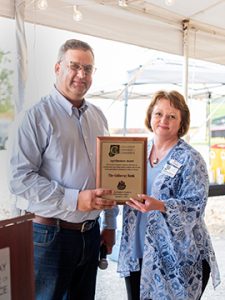
The Callaway Bank team was honored to receive the 2022 Agri-Business of the Year Award at the Callaway Chamber of Commerce Town and Country Dinner.


The Callaway Bank was honored to be named the 2022 Agri-Business of the Year at the Callaway Chamber of Commerce Town and Country Dinner.
The Chamber developed the event more than 30 years ago to improve the “awareness and interaction between industry and agriculture,” the most prominent employment sectors of Callaway County.
The Agri-Business award recognizes a business that “does an excellent job of providing quality products and/or services to the agricultural community in Callaway County.”
Kim Barnes, CEO and President of The Callaway Bank, accepted the 2022 Agri-Business of the Year Award on behalf of the bank and thanked all in attendance for their continued support. The Callaway Bank is the oldest independent bank in Missouri and has solid ties and a deep foundation in agriculture, serving mid-Missouri farmers, ranchers, and ag professionals.

Kim Barnes accepting the 2022 Agri-Business of the Year for The Callaway Bank 2022

The 2022 Agri-Business of the Year Award was presented to Kimberly Barnes, CEO and President of The Callaway Bank by David Backer, President of Wise Bros, Inc.

The Legacy Farmer Award
Jones Angus Farms is a designated “century farm” and has been a diversified farming operation for 128 years. Kenneth and Betty Jones have four generations in their current farming operation.

Hatton Vermeer Sales and Young’s Welding hosted this year’s event, where more than 250 agriculture and business leaders attended.
Bennie Young, owner of Hatton Vermeer Sales gave a presentation providing a history of his family and businesses. In addition, guests could view Vermeer hay equipment and other machinery at the event.

Contact Us 

Is using a Digital or Mobile Wallet a good idea — are they really safe?

The names might be different but they all refer to the same thing: making payments securely with a device. Some of the most popular mobile wallets include Apple Pay, Google Pay, Microsoft Pay, and Samsung Pay, and contrary to what many people think, these payment methods are generally considered to be more secure than using a physical card to make purchases. Physical cards feature an identifying magnetic stripe, and information can be stolen from them rather easily if criminals tamper with a card reader by adding a skimmer.              

A digital wallet — is even more secure than a chip card because it doesn’t use your actual card number for the transaction. As a security measure, your card information is only used in the initial setup of the wallet, helping increase mobile payment protection. Then, the device’s Wallet creates a token (think of it as a temporary card number) that is encrypted and used in place of your card number. The token number is not directly tied to your account, so even if someone were to hack into the merchant and break the token encryption, they wouldn’t be able to access your card or personal information. Additionally, the token isn’t a standard card number that could be used anywhere. It is specifically coded for each transaction, which makes it unusable beyond its intended transaction.

Mobile payment options also offer the added benefit of convenience, since everyone has their phone with them everywhere they go. Transactions via a device are frequently quicker as well. In one study, Apple Pay took just one second, while a card swipe lasted 12. That 11-second difference might seem trivial, but when you’re standing in a long line at a coffee shop or grocery store, that time makes a big difference. Digital Wallets can also be used for online or digital purchases, such as paid apps or subscriptions. 

Mobile Pay can be used for both credit and debit cards and is one more step to no more bulky wallets. 

As we continue to infuse technology with convenience, security will remain a forefront concern for individuals and businesses, especially concerning their financial information. That being said, mobile pay is arguably the safest and most dependable digital method for transactions today. Mobile payment protection technology will continue to evolve and strengthen with each new yearly iteration of device technology. Every day, more and more individuals are deciding to keep their debit cards in their physical wallets, and instead reach for their phone or tap their watches and use a safe mobile payment option. 

Learn More

It’s Easy to Enroll

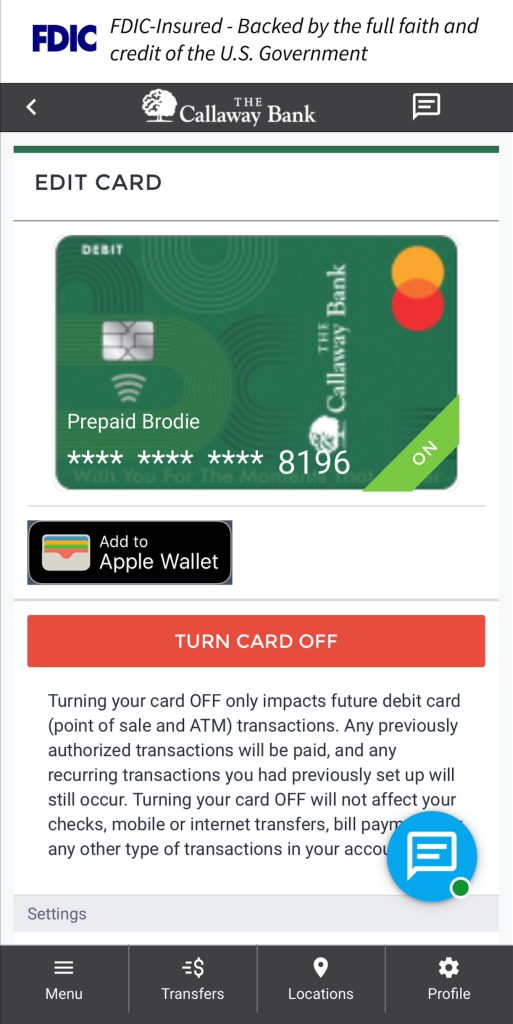
In the The Callaway Bank app, look for the “Add To” option in Digital Banking to enjoy instant Digital Wallet access for your watch and phone!

In Digital Banking > Manage Cards > Tap The Card You Want To Add!

The Callaway Bank Digital  Wallet