We turned $46,500 into $186,000 for Five Area Non-Profits

We turned $46,500 into $186,000 for Five Area Non-Profits 💚

July 30, 2026 – The Callaway Bank has secured an additional $139,500 in gifts to Callaway County by leveraging its $46,500 in charitable contributions through the Federal Home Loan Bank of Des Moines (FHLB Des Moines) Member Impact Fund.

The 3-to-1 matching program quadrupled the impact of the Bank’s original contribution, resulting in $186,000 for five non-profit organizations serving Callaway County residents.

“Our goal was not simply to make a contribution, but to make every dollar we committed work as hard as possible for our community,” said Kimberly Barnes, president and CEO of The Callaway Bank. “By combining our $46,500 investment with the Member Impact Fund, we were able to bring another $139,500 into Callaway County. That means more resources for families, housing, the arts, local entrepreneurs and food security.”

The combined funding will support:

🏊  Callaway County YMCA — $100,000 for their community pool campaign
🏠  Fulton Area Development Foundation — $40,000 for housing development
🎭  Brick District Playhouse — $20,000 for teaching and presenting children’s theater
💡  Callaway Chamber of Commerce — $16,000 for entrepreneur Pitch Competition
🥫  SERVE, Inc. — $10,000 for their food pantry facility

The Callaway Bank made the initial $46,500 in contributions through TCB Cares, the Bank’s community-giving and employee-volunteer program. The Bank then worked with FHLB Des Moines to obtain an additional $3 for every $1 it contributed through the Member Impact Fund.

This matching grant program is designed to amplify the community engagement of FHLB Des Moines member institutions that support local housing, business, and economic needs.  In Missouri, 956 applications received funding through partnerships with 174 member institutions. FHLB Des Moines matched $3 for every $1 contributed by a member institution, resulting in $6.5 million from members and $19.4 million awarded by FHLB Des Moines.

“This partnership allowed us to do something especially meaningful,” Barnes said. “We were able to take dollars generated here, multiply them and bring substantially more funding back into the community. It is a strong example of what a locally owned community bank can accomplish by using its relationships on behalf of the people and communities it serves.”

Since its launch in 2023, the Member Impact Fund has provided more than $106 million in grants from FHLB Des Moines, generating over $144 million in combined support for affordable housing and community development. Notably, every eligible application submitted to the program has received funding, reflecting the Bank’s strong commitment to partnership and impact.

“The Member Impact Fund is designed to help our members champion the organizations that make a real difference in their communities,” said Kris Williams, president and chief executive officer of FHLB Des Moines. “By partnering with our members, we’re able to multiply resources and support their vital work as they continue to strengthen opportunities for the people they serve.”

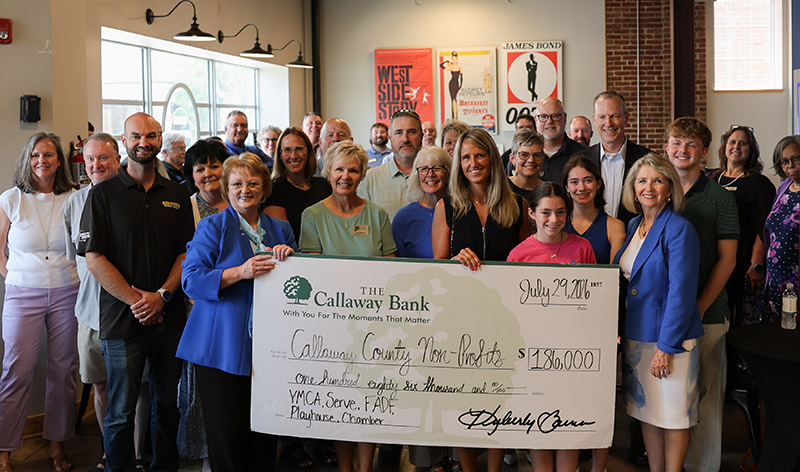
Representatives of The Callaway Bank, FHLB Des Moines, and the five recipient organizations gathered on July 29 at the Brick District Playhouse in Fulton to recognize the awards and discuss the projects the funding will support.

The organizations will receive their allocated funds before the end of August 1, 2026.

Check presentation for $186,000 donation to 5 area non-profits.

How Local Banking Benefits the Community

Knowledge of the many benefits provided by shopping locally has become widespread. Yet, one piece of the sentiment that’s often overlooked is local banking. As with other types of businesses, choosing to work with independent institutions within the community can provide far-reaching rewards for both businesses and individuals alike. If you’re still relying on national chains, here’s a closer look at why it’s time to make the switch.

Why to Choose Local Banking

Keep Funds Local

When you invest money locally, those dollars don’t just evaporate to some corporate headquarters across the country or around the world. Instead, they stay in the community, where they’re reinvested between three and six more times. For instance, research shows when consumers spend $100 at a chain store, only $13 stays in the local community, on average. However, when depositing that same amount at a local business like The Callaway Bank, the number rises to a healthier $48.

Build a Stronger Local Economy

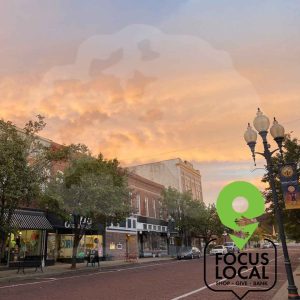
View of Fulton, MO, Main Street with Local Banking Logo These additional funds may go on to help grow small businesses, which increases job opportunities and brings even more money into the community. They can also attract desirable residents and assist with improvement projects, like sidewalk maintenance and park updates. As a result, keeping your hard-earned cash local can end up helping provide a higher quality of life for your family.

Keep Your Money Safe

Banking local also provides peace of mind. A community bank’s focus is entirely local, which often results in taking fewer financial risks and maintaining higher standards. In fact, while big banks across the U.S. were failing during the financial crisis, research shows that local banks were not only surviving but thriving. For that reason, you can bank with the knowledge that your funds are secured.

How to Bank Local With the For Your Community CD

Investing money locally has many clear benefits, and at The Callaway Bank, we don’t just do business in the community; we live in it. As an independent community bank, our neighborhoods are more than just our livelihood; all our decisions center around giving back. That’s why we do all we can to support our local community, including the push to get more individuals to shop local, ourselves as well.

For that reason, we created a unique banking offer for our customers across Callaway, Boone, and the surrounding counties. The “For Your Community CD” is an exceptional investment opportunity that provides a premium rate and supports your community by keeping your dollars local.  Reach out to find which option is right for you!

Contact Us

Why The Callaway Bank is Much Safer Than the Big National Banks

Over the weekend, two large banks in the US were shut down by Federal Regulators, Silicon Valley Bank in California and Signature Bank of New York.  Before we go into further detail, let’s first address the biggest question: do these closures affect The Callaway Bank or your accounts here?  The answer is NO.

First and foremost, The Callaway Bank remains well-capitalized and our client base is well-diversified.

DECORATIVE

The Callaway Bank’s risk profile is entirely different and much more conservative than SVB and Signature Bank.  We do not participate in risky things like cryptocurrencies or venture capital.  We have a low-risk balance sheet, and the Bank is well-positioned with strong capital to continue to serve our customers and community for generations to come.  We were chartered 166 years ago and have steadily served mid-Missouri through every period of unrest since 1857, and we intend to keep serving you.

Additionally, as a federally-insured institution, client deposits are insured by the FDIC up to $250,000, and there are potential ways to provide additional coverage.  Nobody has ever lost a dime of FDIC-insured deposits.

If you have questions about your coverage or would like to learn more about FDIC insurance and how it works, we encourage you to contact us directly at 573-642-3322 or take a look at the resources linked below:


What Happened

Silicon Valley Bank was a unique institution because of its heavy focus on start-up technology companies.  Over the past decade, these companies have received immense funding from venture capital funds and introduced SVB to indirect cryptocurrency exposure.  In the past 12 months, however, venture capital funding slowed considerably, and cryptocurrencies have been volatile.  In recent weeks, venture capitalists began instructing companies in their funds to move uninsured deposits out of SVB.  As a result, investors and clients began to fear potential insolvency, and it started to implode.  Bank regulators stepped in on Friday and put SVB into receivership.

Coincidentally, Signature Bank of New York has been struggling due to its heavy reliance on the cryptocurrency business segment.  Volatility in this sector caused Signature’s deposits to decline precipitously, and on Sunday, Signature Bank was closed and put into receivership as well.

The FDIC, Treasury Department, and Federal Reserve have guaranteed that all depositors of both failed banks would recover all their money.  Additionally, they said taxpayers would bear no losses.  If there are any losses to the Deposit Insurance Fund to support uninsured depositors, a special assessment on all banks will recover the difference.  Even though our community bank didn’t cause the problem, we will play our part to stabilize our country’s financial sector.

While some have suggested this is the start of a 2008 repeat, it’s essential to understand that these circumstances are very different. First, even with the economic challenges we’ve seen overall, the economy is much stronger. Second, SVB and Signature Bank were vulnerable to their high-risk reliance on venture-backed and crypto-focused clients.

Our Bank is Much Different

What happened to both of these banks is extremely unfortunate, and for many months to come, people will speculate on how it could have been avoided. Some will suggest additional regulations are needed. However, we suspect what was missing was an adherence to long-proven sound banking principles of risk aversion, risk mitigation, and diversification.

The approach that multi-billion dollar banks on the east and west coasts use to manage their balance sheets differs significantly from community banks, especially those of us here in mid-Missouri.  The Callaway Bank follows sound banking principles, tried and true and steady through good times and bad. We have a diverse client base of households and businesses of all kinds, and we don’t engage in cryptocurrency activities. The Callaway Bank is well-positioned for today and the future with substantial capital, and we are committed to serving our customers and community for generations to come. If you have any concerns, we welcome you to stop by and let us know what’s on your mind.

Contact Us

2022 Agri-Business of the Year

2022 Agri-Business of the Year, The Callaway Bank

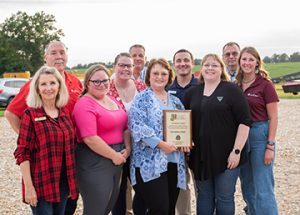
The Callaway Bank team accepting the 2022 Agri-Business of the Year Award

The Callaway Bank team was honored to receive the 2022 Agri-Business of the Year Award at the Callaway Chamber of Commerce Town and Country Dinner.


The Callaway Bank was honored to be named the 2022 Agri-Business of the Year at the Callaway Chamber of Commerce Town and Country Dinner.
The Chamber developed the event more than 30 years ago to improve the “awareness and interaction between industry and agriculture,” the most prominent employment sectors of Callaway County.
The Agri-Business award recognizes a business that “does an excellent job of providing quality products and/or services to the agricultural community in Callaway County.”
Kim Barnes, CEO and President of The Callaway Bank, accepted the 2022 Agri-Business of the Year Award on behalf of the bank and thanked all in attendance for their continued support. The Callaway Bank is the oldest independent bank in Missouri and has solid ties and a deep foundation in agriculture, serving mid-Missouri farmers, ranchers, and ag professionals.

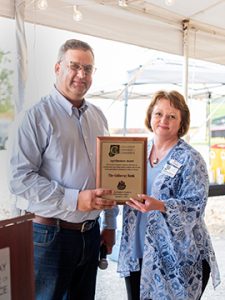
Kim Barnes accepting the 2022 Agri-Business of the Year for The Callaway Bank 2022

The 2022 Agri-Business of the Year Award was presented to Kimberly Barnes, CEO and President of The Callaway Bank by David Backer, President of Wise Bros, Inc.

The Legacy Farmer Award
Jones Angus Farms is a designated “century farm” and has been a diversified farming operation for 128 years. Kenneth and Betty Jones have four generations in their current farming operation.

Hatton Vermeer Sales and Young’s Welding hosted this year’s event, where more than 250 agriculture and business leaders attended.
Bennie Young, owner of Hatton Vermeer Sales gave a presentation providing a history of his family and businesses. In addition, guests could view Vermeer hay equipment and other machinery at the event.

Contact Us 

Agriculture Lending is Essential to Missouri

If you ask most people where their food comes from, they’ll list off a few preferred grocery stores and maybe a specialist like a butcher shop. In Missouri, where farms make up two-thirds of the total land acreage, we know better. 

Small Missouri farms have a big impact on the local economy. Almost all the state’s farms (nearly 100,000 of them) are family-owned, with an average plot size of 269 acres. Viewed as a whole, these farms contribute a combined $88.4 billion to the state’s economy — and the entire agriculture industry supports over 370,000 jobs. 

Missouri agriculture is essential to every resident of the state. Farms put food on the table and money in bank accounts. Agriculture has a rich history here and will continue to be a critical component of what makes the Show-Me state so great. From generational farm families to new farm endeavors, the Missouri agriculture industry couldn’t exist without agriculture lending. 

As a financial institution, we understand how financing is necessary to get your operation up and running, cover the upfront costs of new equipment, or acquire more land. Agriculture lending gives farms the flexibility they need to continue being the backbone of this state.

Here at The Callaway Bank, we appreciate every farmer, rancher, and agribusiness person. They do a tremendous job that, frankly, many people take for granted. We encourage you to take a moment to thank a farmer for his or her hard work, not just today, but year-round!

Agriculture Goes Beyond Crops and Cattle

Thanks to the state’s rich diversity of terrain, farmers in Missouri grow a wide variety of crops. Soybeans are Missouri’s biggest commodity, and the 5 million acres of soybeans sell for about $2.2 billion annually. The 3 million acres of corn take second place when it comes to generating revenue, and there are more than 2 million cows throughout the state. But the state’s agriculture production extends beyond the traditional ideas of just crops and cattle. Farmland is used in a variety of ways to generate business and tourism for the state.

There are also more than 130 wineries in the state, operating on 1,700 acres of grapes. In addition to unique and robust wines, these farms create hotbeds of tourism. Where a winery appears, tourist attractions such as restaurants, bed-and-breakfast establishments, and local craft shops are sure to follow. 

Another unique facet of the Missouri agricultural industry is beekeeping. Local example “beeing” Giofre Apiaries, a mid-Missouri company that makes commercial ice cream with honey the owners farm themselves. Nancy and Domenic Giofre started beekeeping in 2009 with two small hives. A decade later, they continue to add hives to produce more honey for their ice cream. They now have 25 different flavors, ranging from standards such as vanilla and chocolate to new varieties like elderberry, cherry blossom, and salted caramel. 

We could continue, but the point is that agriculture and farmers contribute to aspects of our lives and the economy that we don’t often consider. It’s important to remember where our food comes from and the people who work hard to provide it.

Financing Missouri Farms Through Agriculture Lending

From corn to cows to hens to honey, Missouri agriculture contributes to the economy in countless ways. The Callaway Bank is proud to offer financial tools that support the agricultural community — something that we’ve been doing for more than 160 years. Our Ag Lenders come from farming backgrounds and have extensive experience with the unique demands of agribusinesses because they’re farmers, too. 

We know what it’s like to be in your shoes. So we try to always meet your needs, communication preferences, and schedules. Want to meet on your farm before sunup? So do we. We’re happy to discuss our agriculture lending options, including loans for land, livestock, equipment, or crops. Need a flexible payment plan? We can help. Want to make one single payment per year? That’s an option. Missouri agriculture is important to us, and always will be. We want to prioritize your needs so we can help continue to make you successful, season after season. Our ag lending options are designed to help farms of any size and specialty.

With You For the Moments That Matter

At The Callaway Bank, we make client-focused decisions on a local scale, and our goal is to help you find the right loan solution to fit your unique situation. Whether you’re refinancing your farm or need a loan for an expansion, contact an Ag Lender at The Callaway Bank for all of your agricultural lending needs!
Contact an Ag Lender


#AgDay2021, #NationalAgWeek, #ThankAFarmer

The Benefits of Shopping Local Ripple Through Communities

“Shopping local” has been a buzzword for years, but it’s only becoming more relevant as online retail continues to gain momentum. So, why shop local? The reality, of course, is that a dollar spent locally pays dividends for a community in ways that online purchases just can’t. Fortunately, recent data¹ has shown a sharp increase in consumers planning to shop at small businesses – up more than 25 percent. The benefits of this behavior are clear.

Local Economy

When you spend money locally, those dollars don’t just evaporate to some corporate headquarters across the country or around the world. Instead, they tend to stay in the community, where they’re reinvested between three and six more times. When consumers spend $100 at a chain store, only $13 stays in the local community², on average. At a local business, that number rises to a healthier $48.

Local Business

The need to shop local is even more important now, as many communities, including our own, have felt the financial impacts from COVID-19. The past few years have been hard for independent business owners to keep positive profit margins while navigating health guidelines and consumer concerns. This leaves it up to us, the fellow community members, to prioritize shopping locally, to keep our towns economically healthy, and our neighbors doing what they love — serving this community. The benefits of shopping local are not only felt in the pocketbooks of these store owners but almost everywhere.

Schools

Local spending is one of the most important sources of tax income for local and state governments. K-12 schools, in particular, rely heavily on the financial resources³ of these government bodies — about 47 percent of school revenues come from state funds and another 45 percent comes from local governments. The small need remaining is what’s met by the federal government, which is the story for most other public assets as well.

Public Services

While the federal government helps to build and maintain public assets, state and local governments generally cover three-quarters of the cost of maintaining and improving these assets. When it comes to the foundation of a state’s economy — specifically schools, water treatment and distribution, and transportation — state and local governments spend 90 percent of their tax revenue⁴ on these projects.

In order to accurately measure tax revenue generation and compare one area to another, a “per acre” figure helps to illustrate the source of tax dollars. While a typical big-box retail store will earn a county around $7.11 per acre in tax revenue, the same area generates $287.55⁵ in a mixed-use business district that you’d typically find on Main Street, USA.

Real Estate

Tax revenues aren’t the only benefit, however. When you shop local, supported independent businesses are also a boon to the real estate market, and on average, home values in these neighborhoods increase by 50 percent⁶.

Jobs

These businesses are also responsible for creating around two-thirds of private-sector jobs⁷. Every $10 million spent at local businesses results in 57 jobs. The same amount spent at online retail giant Amazon creates just 14 jobs — and those jobs aren’t in the community. Just think about that. When you shop local, you are helping protect the jobs of your family, friends, and neighbors, as well as creating new employment opportunities for your community in the future.

Shop Local, Give Local, Bank Local

There are many clear benefits to spending money locally, and at The Callaway Bank, we don’t just do business in the community; we live in it. As an independent community bank, our neighborhoods are more than just our livelihood, and all our decisions center around giving back. That’s why we do all we can to support our local community, including the push to get more individuals to shop local — including ourselves.

Learn more about the benefits of banking local.

Sources:
¹;vistaprint.com, Vistaprint® Consumer Survey ²;amiba.net, Ten Studies of the “Local Economic Premium” ³;cbpp.org, A Punishing Decade For School Funding ⁴;cbpp.org, It’s Time For States To Invest in Infrastructure ⁵;ilsr.org, Key Studies: Why Local Matters ⁶;huffingtonpost.com, Small Businesses are the lifeblood of local communities ⁷;bealocalist.org, Why Local Matters

Help us support our local shops! Join the Callaway Bank Rewards Program!

Callaway Bank Rewards

Benefits of Using a Community Bank vs. a National Bank

Who you bank with matters.

It’s not just a choice you should make blindly. Your bank helps you manage your money, protect your money, and grow your money. In most parts of the country, you have multiple banking options, including both local community banks and national banks.

The decision on which type of bank to use depends entirely on your goals and what’s important to you. In larger metropolitan areas, you often see more national bank chains such as Chase or Wells Fargo. However, in less densely populated areas and smaller cities, local banks are more common to see and service the community.

So what exactly classifies a community bank and a national bank?

Community banks offer more than just banking services. They offer a relationship that can benefit you throughout your life or entrepreneurial journey. These depository and lending institutions are available in large metropolitan areas as well as in rural areas. 

Unlike megabanks, community banks are entrenched in their communities. They support individuals, small businesses, and non-profit organizations through thick and thin. Their success is tied to their community and the customers they serve. 

Community banks are much smaller than megabanks which allows them to focus on building personal relationships with their customers, working to know and serve their needs on a case-by-case basis. However, being small doesn’t mean unsafe. Nearly all community banks are insured by the FDIC (Federal Deposit Insurance Corporation), which protects depositors up to $250,000 in case of a bank failure.

There are roughly 5,000 community banks spread across the United States. In a 2019 survey conducted by the Federal Reserve, 79 percent of community bank small business customers were reported to be happy with their lending bank. This is 12 percent higher than small business customers who had a loan with a national bank.

In a 2016 op-ed in The Wall Street Journal, JPMorgan Chase CEO, Jamie Dimon wrote about the attractiveness surrounding community banking.

“[Regional and smaller community banks] sit close to the communities they serve; their highest-ranking corporate officers live in the same neighborhoods as their clients. They are able to forge deep and long-standing relationships and bring a keen knowledge of the local economy and culture. They frequently are able to provide high-touch and specialized banking services.”

On the other hand, national or megabanks are commercial banks chartered by the United States Treasury and are required to be members of the FDIC. National banks serve both individuals and businesses of all sizes. These banks are publicly traded companies where any individual can buy and sell company stock. The four biggest banks in the United States include JPMorgan Chase, Bank of America, Wells Fargo, and Citibank. The majority of Americans do their banking at commercial banks like these.

What is the difference in experience between community banks and mega national banks, and what might be right for you?

Typical Mega/National Bank Experience

Megabanks have an extensive regional reach, if not national. In large metropolitan areas, they have numerous branch locations and ATMs. They offer their customers a nationwide network of banking locations, which prior to digital banking tools, helped people managing their money if they worked across the country or when traveling. Businesses with locations in multiple states may benefit from their multi-state branches.

However, while these giant banks may offer a wide selection of banking and loan products, the experience can be lacking. Clients regularly report feeling like a number and not recognized for their specific needs.  When problems arise, these banks are less likely to be understanding or willing to address your personal needs.  Their policies leave little wiggle room, and they are often less understanding of their customers’ daily lives and needs. They can be less flexible or forgiving regarding personal circumstances should you or your business have special needs or fall on hard times.

With national banks, there is less attention or focus on the local communities in which they operate. It is not feasible or in the best interest of megabanks to have a community-by-community approach. Whether it is supporting local non-profit organizations or civic improvement initiatives, historically, megabanks do not provide much in resources. Because they are publicly traded companies, their interests are hinged on what is best for investors and prominent stakeholders in the short term, not necessarily what best serves a community or customers over the long run. Nearly all revenue these banks generate is pulled out of their local communities and consolidated at their headquarters, rather than recirculating it within the local communities.   

Typical Community Bank Experience

Community banks approach banking with a much different mindset than megabanks. Their success is tied directly to the success of their communities. Community banks can range from one location to dozens, but they are usually concentrated within a localized geographic area. This has advantages in how operational decisions and loan decisions are made. Not to mention advantages to customers in the attention they receive.  

Technology is usually not an issue for customers of community banks. While some of the smallest banks may have fewer mobile or digital banking options, most community banks provide digital and technology services comparable to national banks. Services such as mobile apps, mobile check deposit, and online bill pay are commonly available. Business services such as direct deposit and wires are widely available with community banks. 

However, the biggest draw to community banks centers around the personalized attention and care they can provide. Rather than a sterile experience that feels like you’re just a number or another transaction, community banks often know their customers on a first-name basis. They understand their needs. They know what they do for a living and how their family is doing. Small business owners don’t feel overshadowed by large business customers because small business is a critical sector for community banks.

Lending decisions at a community bank are made locally, allowing their lenders more input. Community bank lenders have a better understanding of the challenges and opportunities that their customers face. They have a stronger relationship with their clients and can provide better insight.

Community banks are owned and operated by individuals who live in the community and often next door to their customers. They understand their community and the ongoing financial ups and downs of it. This information and participation in the community enable banks to make business decisions that are beneficial to the community. They don’t have to worry about being held accountable to wall street investors or megabank executives.

These smaller community banks are also a key player in helping uplift local businesses and individuals. Community banks tend to be more flexible and understanding with loans and accounts than national banks who feature a rigid set of guidelines and rules. They also tend to have lower fees associated with their products and services compared to their larger counterparts. Additionally, local banks are interested in investing in their own community through donations, sponsorships, and events that benefit their customers.

The Best Community Bank in Central Missouri

The Callaway Bank is a central Missouri community bank dedicated to building lasting relationships and elevating their clients and communities through moments that matter. Founded more than 160 years ago, they are still locally owned and operated. The Callaway Bank offers a strong selection of banking products and services to small businesses and individuals. See what their clients say about banking with them. Get in touch with them and learn how they can help you pursue your passions through moments that matter.

Consumer Alert: Mortgage Scam

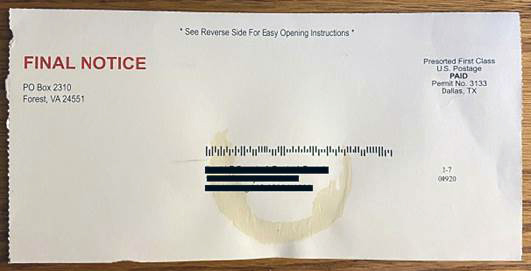
Have you received a postcard or letter with “an important matter” regarding your mortgage?

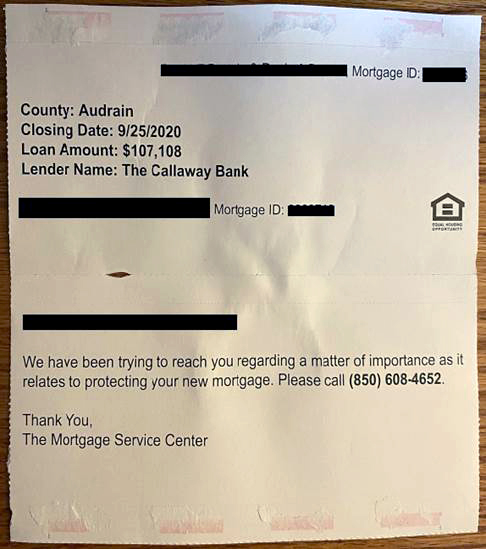
Have you received a postcard or letter about a time-sensitive issue with your mortgage urging you to call an unknown phone number? If you have, you are not alone. Scammers all across the country are pulling public data records to target you and your information.

The first thing to understand is that these mailings did not come from The Callaway Bank or any other financial institution. They are sent to homeowners in the hopes of selling them something or, most often, to steal their identity by tricking them. Recipients are asked to call a phone number about an “important matter” with their loan. This scam is especially tricky because it looks like a late notice or official letter that mentions your lender by name.

The notices will often have a small disclaimer on the bottom stating, “Not Affiliated With” and your lender name. However, in the example below, there is no mention of that.


Final Notice Scam MailMortgage Scam Mail


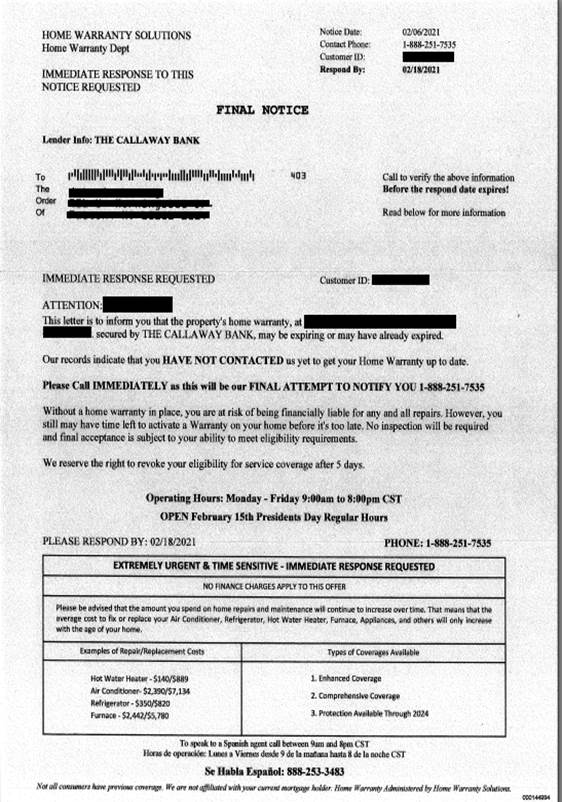
The example seen below is from Home Warranty Solutions and mentions The Callaway Bank as the lender. According to The Better Business Bureau, Home Warranty Solutions has a C rating and not BBB Accredited. The letter also gives the impression that they are working with the bank. But that is not true at all.


Home Warrenty Solutions scam mail


The Callaway Bank is committed to protecting your personal information, and we do not sell or otherwise distribute it to non-affiliate third parties. There is some information with mortgages, regardless of what lender you might have worked with, that is public record. Public Record entries are how scammers like this obtain your information. For example, companies can get information from a county recorder’s office, such as lien filings or property purchase and transfer documents, which are all public records. The records and the information they can gather are used to develop letters with detailed information to help legitimize the “important matter” they refer to.

If you receive the notice, disregard and dispose of it as you would any other junk mail. Calling the number may connect you with a real person, or it may connect you to an automated recording. Regardless, do not offer your personal information. It could lead to some unfortunate problems.

Please contact us for any questions you may have.